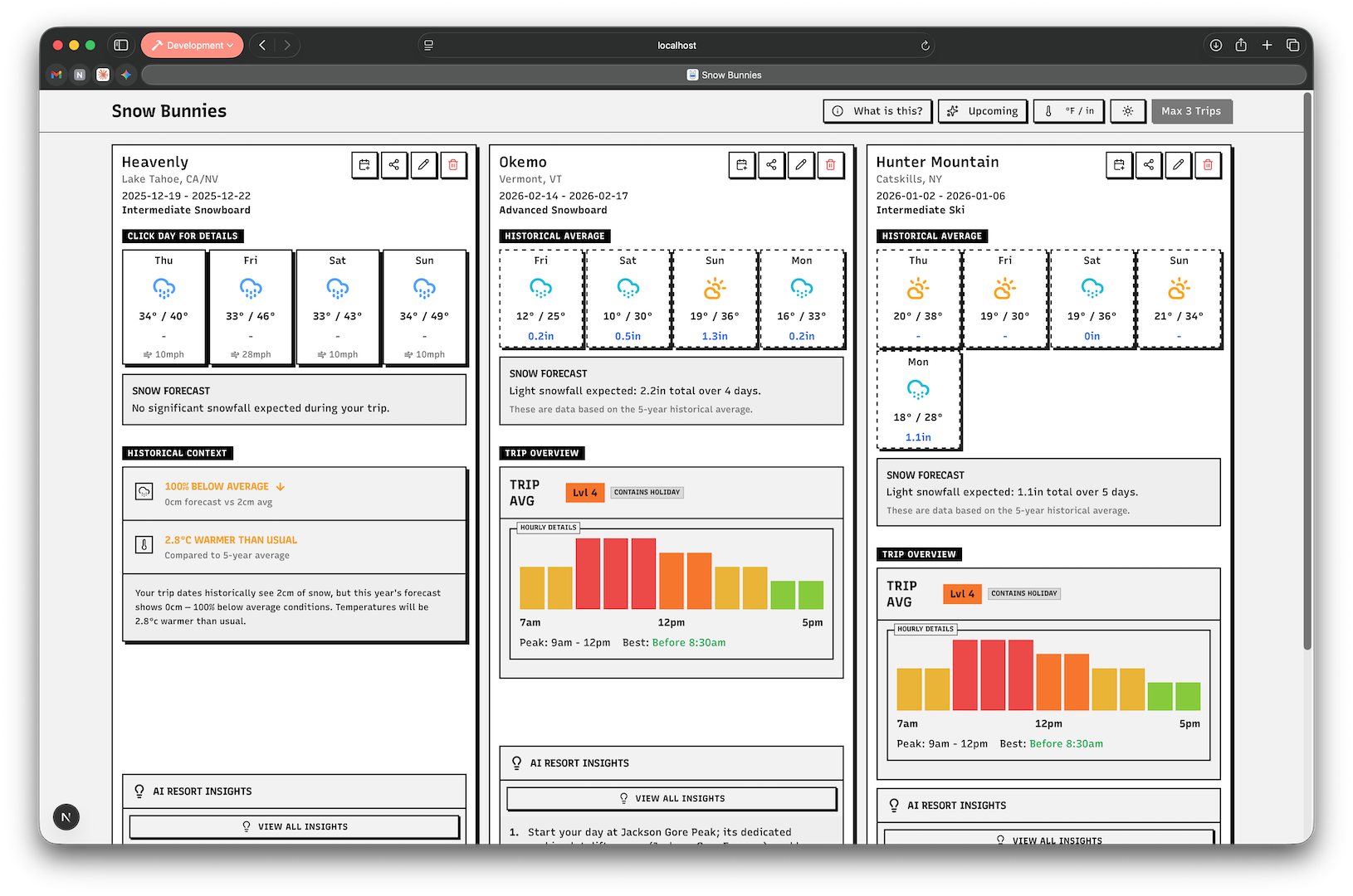
 https://snow-bunnies.vercel.app
I'll try to keep this short, but to pique your interest, this is a fully functional, reliable software that I will personally use, along with my friends, for the upcoming ski trips.
Origins
I was planning 3 skip trips with 3 separate friend groups. First one in Heavenly, second in Okemo, and third in Hunter. For some reason, nobody really wants to care about how the snow will be on the selected trip dates. At some point we're getting closer to the trip, and they're all asking me about the forecasts, at the same time. So naturally I 'scrambled' different sources to find information on the weather, drive, accommodation, food, etc., because I don't have OpenSnow (yeah I know, but I already paid bank for Surfline). All that for 10+ different heads with different skill levels across two different disciplines (ski/snowboard).
This was around the time I was introduced to the 'proper' way to vibe code through several engineer friends of mine. They were crashing my place, and so their geek spread all over. Antigravity came out weeks earlier, and I have the Pro plan, so I have plenty of free tokens. So I just decided to open Antigravity out of boredom and started yelling at the agent.
The Proper Way
Spec-based prompting is the way if you want proper architecture and design. I spent at least 15 minutes with Opus 4.5 Thinking to figure out the best architecture and design guidelines. Once I got the outline file, I simply put it into the project directory and say "Do it".
The point of Antigravity is their parallel processing. You can have multiple agents work on multiple domains, on the same codebase, at the same time. So I did exactly just that. Most of my time is spent reviewing AI code– I'd say 90%, 5% of waiting and 5% texting my friends back home in Jakarta.
What I learned: the code quality depends on your brain, how you translate that into text, and how you can leverage LLMs to improve the prompt. Who knows LLMs better than themselves innit?
Feature Set
I know what I'm trying to build from the start. A minimalistic, reliable and lightweight ski trip planner and tracker so I can snowboard in peace. I also know what my friends need: a simple interface, AI insights to save research that is based on their skill level and sports preference.
All of this is defined in the initial spec file. It's a long file, which is available for your viewing in the GitHub repository (including other spec files such as design).
Once you have that set down, each prompt should have that in context. That way, they hallucinate less and won't get too creative.
Supervision
In the end, you are a senior or lead engineer with 5+ junior developers that actually knows how to read documentation and that you severely underpay. But as your job as a high-level dev, you need to make sure what they shit out is actually good quality shit. It doesn't need to be perfect– the same principles you apply to your actual job or any OSS project really.
Each feature branch or commit should be reviewed manually. Lints and formatting are taken care of by the agent, so all you need to care about is core correctness, idiomacy, efficiency and manual testing that only a good human eye can catch. QA, basically.
Results
You can see it on your own: https://snow-bunnies.vercel.app
I won't repeat what it does and what's coming since all is laid out in the app. It's better for you to judge yourself what comes out of the sloppery that was a combination of Antigravity with Claude Code.
Evaluation
I was a vibe coding skeptic. I know for a fact AI will change the industry, but I've for the longest time believed that it won't really change how we work fundamentally. I know it'll help with speed and accuracy. But this project shifted my views.
It does change how you build fundamentally. Sure, it's skewed towards web development because ease of setup, build times, compatibility and domain-awareness (as opposed to, say, Xcode iOS), but it remains the fact that this way of development is undisputedly the fastest in code generation. The bottleneck are reviews and debugging, but that's always been the case in traditional development. Just like how modern developers does not need to know the inner workings of HTML and DOM rendering via frameworks like React and Vue, at some point it's not as important to over-emphasize the code itself.
But for one to have a good resulting codebase one still need to be a good engineer. The meaning of a good engineer does not change. You need to have a good perspective and sensitivity to design, scalability and security.
What changed is the time you waste doing boring shit: centering divs, basic existing security patterns, etc.
Besides, it's fun!